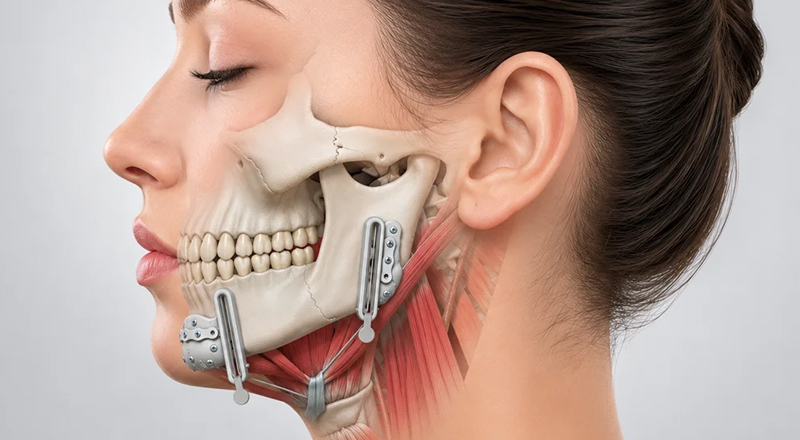
Jaw & Facial Bone Reconstruction
Resection of the jaw (mandible or maxilla) for cancer treatment can significantly affect chewing, swallowing, speech, and facial appearance. Jaw and facial bone reconstruction aims to restore the structural integrity of the lower and upper jaw, re-establish dental occlusion where possible, and preserve or improve quality of life following cancer surgery. Dr. Antony Raj James has specialized training in head and neck oncology and experience in jaw and facial bone reconstruction as part of comprehensive head and neck cancer management.
Mandibular (Lower Jaw) Reconstruction
When a portion of the mandible is removed during cancer surgery (segmental mandibulectomy), reconstruction is typically required to restore jaw continuity, support oral function, and maintain facial contour. Options include:
- Fibula Free Flap – The fibula bone from the lower leg is the most widely used donor site for mandibular reconstruction. The fibula provides a long segment of cortical bone that can be osteotomized (cut and angled) to reproduce the shape of the mandible. A skin paddle can be included to reconstruct intraoral soft tissue simultaneously.
- Iliac Crest Free Flap (DCIA) – The iliac crest provides cancellous and cortical bone with a natural curvature that can match the mandibular shape, particularly for anterior arch defects.
- Reconstruction Plate – In selected cases, a titanium reconstruction plate may be used as a bridge for smaller defects or as a temporary measure, though vascularized bone is preferred for definitive reconstruction of segmental defects.
Maxillary (Upper Jaw) Reconstruction
Maxillectomy defects — following surgery for upper jaw or palate cancer — may be reconstructed surgically or managed with prosthetic obturators depending on defect size, patient factors, and adjuvant treatment plans. Surgical reconstruction options include:
- Free flap soft tissue reconstruction to seal the palatal defect (radial forearm or ALT flap)
- Composite vascularized bone and soft tissue reconstruction for larger defects involving the alveolus
- Prosthetic obturator fabricated in collaboration with a maxillofacial prosthodontist
Virtual Surgical Planning (VSP)
Advanced cases may benefit from virtual surgical planning, where pre-operative CT imaging is used to digitally plan the osteotomies and bone shaping required for precise jaw reconstruction. Custom cutting guides and pre-bent plates may be fabricated to improve accuracy and reduce operative time.
Dental Implants After Jaw Reconstruction
Vascularized bone reconstruction of the jaw is designed to be implant-compatible in the long term. After healing and completion of adjuvant treatment, dental implants may be placed into the reconstructed bone to support prosthetic teeth, significantly improving chewing function and quality of life.
Why Choose Dr. Antony Raj James?
- Specialized Head & Neck Oncology Training – MCh in Head & Neck Oncology from Tata Memorial Hospital/ACTREC, Mumbai.
- Jaw Reconstruction Expertise – Experience with fibula free flap and composite bone reconstruction for mandibular and maxillary defects.
- Functional Focus – Reconstruction planned to restore chewing, swallowing, speech, and facial appearance.
- Multidisciplinary Approach – Coordinated care with prosthodontics, dental oncology, and radiation oncology for comprehensive rehabilitation.