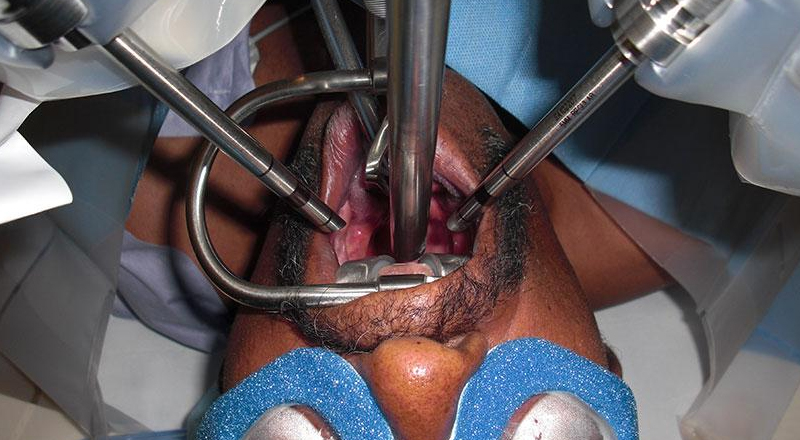
Minimally Invasive Throat Cancer Surgery (TORS / Laser Surgery)
Minimally invasive surgical approaches — including Transoral Robotic Surgery (TORS) and laser-assisted surgery — offer selected patients with throat (oropharyngeal and laryngeal) cancers an alternative to open surgery or primary radiation. Dr. Antony Raj James has specialized training in head and neck oncology and works within teams that utilize minimally invasive surgical techniques for appropriate candidates.
What is TORS (Transoral Robotic Surgery)?
Transoral Robotic Surgery (TORS) uses a robotic surgical system with small, wristed instruments introduced through the mouth to reach and remove tumors in the throat. The robotic platform provides enhanced visualization, precision, and dexterity compared to conventional transoral resection, enabling surgery in anatomically challenging areas such as the base of tongue and tonsil region.
TORS is particularly used for selected oropharyngeal cancers and allows tumor removal without external incisions, potentially reducing the side effects associated with open surgery and, in some cases, allowing de-escalation of adjuvant radiation therapy.
What is Laser Surgery for Throat Cancer?
Transoral Laser Microsurgery (TLM) uses a high-energy laser delivered through a microscope and laryngoscope introduced through the mouth to precisely excise tumors of the throat and larynx. It is used for selected cancers of the larynx (voice box), hypopharynx, and oropharynx where the tumor is accessible and can be excised with adequate margins through the transoral route.
Laser surgery can offer voice preservation, reduced hospital stay, and faster recovery compared to open surgical approaches in appropriately selected patients.
When are Minimally Invasive Approaches Considered?
Minimally invasive approaches are considered for patients with throat cancers where:
- The tumor location and size allow adequate transoral access and margin control
- The patient's anatomy permits safe introduction and use of the robotic or laser system
- The oncological goals of the surgery can be achieved through the minimally invasive route
- The patient may benefit from reduced surgical morbidity compared to open resection
Patient selection is critical. Not all throat cancers are suitable for minimally invasive surgery, and the decision is made following detailed assessment and multidisciplinary tumour-board review.
Neck Dissection When Required
Even when the primary tumor is removed through a minimally invasive transoral approach, neck dissection is frequently required to address regional lymph nodes. This is typically performed through a separate cervical incision and may be done concurrently or sequentially. Dr. James has extensive experience with selective and comprehensive neck dissections at all relevant nodal levels.
Benefits of Minimally Invasive Surgery in Selected Patients
For appropriately selected patients, minimally invasive throat cancer surgery may offer:
- Avoidance of external facial or neck incisions for the primary tumor resection
- Reduced disruption to surrounding tissues
- Shorter hospital stay and faster recovery in suitable cases
- Potential for voice and swallowing function preservation
- Possibility of de-escalating adjuvant radiation therapy in certain oropharyngeal cancers (TORS)
Multidisciplinary Cancer Care
Minimally invasive throat cancer surgery is one component of a comprehensive treatment strategy. Dr. James participates in multidisciplinary tumour-board discussions to evaluate whether a minimally invasive approach is appropriate for each individual patient, and to integrate surgical planning with radiation and medical oncology strategies when adjuvant treatment is required.
Why Choose Dr. Antony Raj James?
- Specialized Head & Neck Oncology Training – MCh in Head & Neck Oncology from Tata Memorial Hospital/ACTREC, Mumbai.
- Extensive Head & Neck Cancer Surgery Experience – Experience in complex oropharyngeal and laryngeal cancer surgery including minimally invasive approaches.
- Patient-Centred Surgical Planning – Treatment approach tailored to individual tumor characteristics, anatomy, and functional goals.
- Multidisciplinary Approach – Complex cases are evaluated through coordinated tumour-board discussions and evidence-based treatment planning.